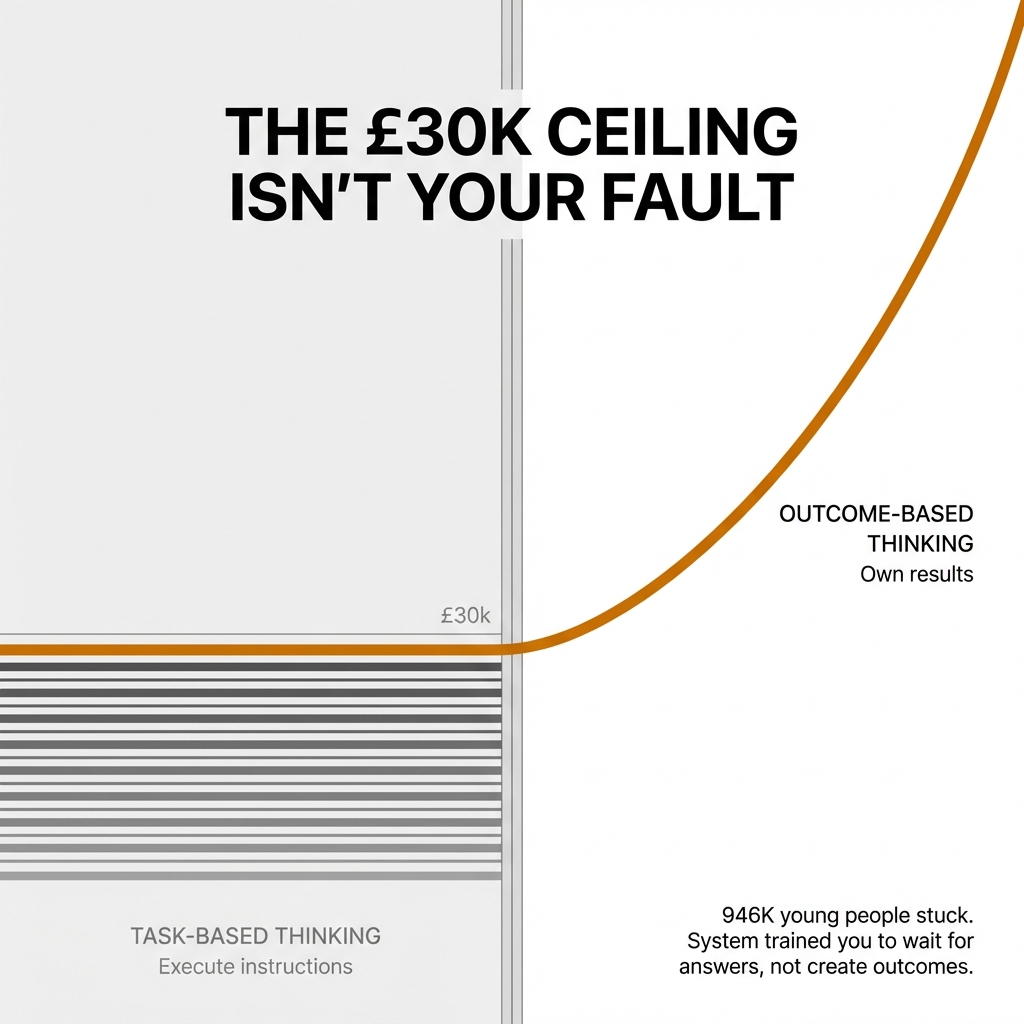
The Education System Built You to Follow Orders, Not Create Value
TL;DR: UK rote learning trains you to execute tasks, not own outcomes. This creates a £30k career ceiling. The system produces 946,000 NEETs and doubles career uncertainty since 2018 because it was designed for factory work, not 21st-century careers. Outcome-based thinking breaks the ceiling.
Core Answer:
Task-based thinking (what you do) keeps you at £25-35k
Outcome-based thinking (results you create) breaks you through £40k+
Schools teach memorization and compliance, not critical thinking or problem-solving
92% of hiring managers value soft skills equally or more than technical skills
You need to reposition from "I manage the CRM" to "I freed 8 hours/week for sales, worth £40k"
Why You're Stuck at £27-30k (And Why It's Not Your Fault)
You did everything right. Got the grades. Picked the sensible path. Walked into a decent job.
Nobody mentioned you'd still be stuck at £27-30k.
The problem isn't you. The system trained you to wait for instructions instead of solving problems. It taught you to memorize answers for exams, not think critically about outcomes.
Years into your career, you're realizing task-based thinking keeps you cheap. Outcome-based thinking breaks you through the £40k+ barrier.
The education system works exactly as designed. For 20th-century factory floors, not 21st-century career architecture.
What the Data Shows About UK Career Stagnation
946,000 young people aged 16-24 are Not in Education, Employment, or Training (NEET). That's 12.7% of this age group. An 11-year high.
The proportion has been climbing since 2021.
46.4% of UK young people are uncertain about their career options. That's double the 24.6% rate from 2018.
The UK now ranks among the worst countries globally for youth career uncertainty.
These aren't random failures. They're predictable outputs. The system was never designed to teach critical thinking.
I saw this across Newcastle, Durham, Manchester, the West Midlands. Every retail location where I trained staff.
Whether they sold clothes at Burton's, miniatures at Games Workshop, or phone contracts at Three UK, they needed different product knowledge.
They all struggled with the same thing: conversational skills and critical thinking.
Bottom line: The education system creates predictable career ceilings because rote learning doesn't teach outcome thinking.
How Rote Learning Gets Built Into You (From the Classroom)
After being made redundant during COVID, I went back to college as an adult learner. I was 35, sitting in a hairdressing course alongside people who'd never worked. Straight from school to college, then more college.
That's when I saw the factory floor.
Teachers wanted to ask students what they thought. You could see them trying.
But the curriculum had a single answer. One correct response to pass the exam.
If a student offered a different answer (even a thoughtful one), it was marked incorrect.
Not shut down nastily. Just wrong.
Students stopped trying. They stopped raising their hands.
The classroom stopped being a place for thinking. It became a place for memorizing the right answer to pass.
Even in practical courses like hairdressing, there was "the way" to do things.
No room for experimentation. No encouragement to observe, adjust, and learn through failure. Engineers spend 99% of their time iterating until they get results. Schools don't teach that.
Rote learning stifles creativity and critical thinking. Students become passive recipients of information, rarely encouraged to question, analyze, or interpret.
They focus on recalling facts, not understanding principles they can apply.
What this means for you: School trains you to wait for instructions, not solve problems. This becomes your default mode in the workplace.
Why the £30k Ceiling Is Architectural (Not Personal)
I remember one girl in my college class. She was 20.
Talking to her about aspirations felt like talking to a preteen. She had no sense of who she wanted to be, where she wanted to go, what problems she could solve.
I thought she was a one-off.
Then I had the same conversation with others.
Some had complete apathy. No drive to do anything or be anywhere.
Others had resigned anger: "This is who we are, this is what life's like for us, nothing's going to change."
A fixed mindset.
These people end up in two segments:
"Apprentice Ambitious": Non-university route, earning £27-35k, hitting an invisible ceiling
"Degree Disappointment": University route, same salary bracket, same ceiling
The route doesn't matter. Both paths trained them to execute tasks, not own outcomes.
When I was training retail staff years earlier, I thought it was their fault.
I'd been taught sales skills and relationship-building from mentors in retail management. I measured success through results, deliverables, improvements.
I assumed everyone naturally thought that way.
They didn't.
I had to help them find their own drivers first before I could teach them anything about sales.
How do people not understand their own motivation? How do you succeed in any career without knowing what drives you?
Then I realized: school never taught them to think about themselves that way.
The pattern: The education system builds task-executors. Breaking through £40k requires outcome-ownership.
What the System Gave You Instead
The education system teaches you to be an employee. A factory worker. Someone who executes the action they want you to take.
It doesn't teach you to step outside a situation and solve problems. It teaches you to block curiosity and stop questioning.
Parents do it too. When your kid asks "Why do we have to do it that way?" the easy answer is "Because that's the way we do it." The real answer involves helping them see the outcomes of different choices and weighing those options.
I’m no hero either, I get it, and have done it before. When you're late for school and your kid has the wrong shoes on, there's no time for that conversation. Pressure's on. You need to get out the door.
Scale that up to employers and employees across the entire economy. If everyone questioned everything all the time, nothing would get done. There's strength in just getting on with things.
But here's the tension: if you want to break through career ceilings, you have to question what you're doing. You have to strengthen who you are first so you can do the things that give you the life you want.
School teaches you not to question so you'll be a good employee. But life needs you to be the person you can potentially become. The only way to do that is to continually observe, adjust, and climb the next rung of your potential.
The Market Gap Is Massive
Employers are desperate for what the education system isn't producing.
92% of hiring managers now consider soft skills (like critical thinking and problem-solving) equally or more important than technical expertise. 77% of CEOs identify the lack of soft skills as a major hurdle to organizational growth.
The global soft skills market is projected to reach $43-71 billion by 2031-2033. The UK market alone is growing at 8.7-10.57% annually.
Here's what that data really means: companies are willing to pay for outcome-focused critical thinkers, but the education system keeps churning out task-executors.
Research on over 1,000 occupations and 70 million job transitions found that people with a broad base of foundational skills (like critical thinking) learned new things faster, earned more money, moved into more advanced positions, and proved more resilient when markets changed.
Rote learning gives you narrow, specialized recall. Critical thinking gives you adaptability and the ability to own outcomes.
That's the difference between staying stuck at £30k and breaking through to £40k+.
What Critical Thinking Looks Like in Practice
I trained a young person at Three UK who was about 22. Before we worked together, if you asked what they did, they'd say "I sell phones and contracts" or "I help customers upgrade their devices."
Very transactional. Very task-based.
They'd rattle off features. "This phone has a better camera, this tariff gives you more data." But there was no connection to why any of that mattered. They were reciting what they'd been told to say, like reading from a script.
Customers could feel it. Their numbers showed it.
After we worked through an outcome-focused approach, everything shifted. They started saying things like "I help people stay connected to what matters to them" or "I figure out what's costing them money or frustration with their current setup, and I fix it."
In conversations, instead of leading with "This phone has 128GB storage," they'd ask "What's slowing you down right now?" or "What are you trying to do that your current phone can't handle?"
Then they'd translate features into outcomes: "That extra storage means you stop running out of space when you're trying to capture your kid's football match." Or "This unlimited data plan means you stop worrying about overage charges when you're streaming on your commute."
The difference was night and day.
They went from being another person behind the counter to someone customers actually trusted. Their sales went up. But more importantly, they started to see themselves differently. They weren't just "a phone salesman" anymore. They were someone who solved problems.
That shift in identity is what the education system never gave them.
The System Isn't Broken. It’s Outdated
Former US Secretary of Education Richard Riley said: "We are currently preparing students for jobs that don't yet exist, using technologies that haven't been invented, in order to solve problems we don't even know are problems yet."
Yet the UK education system continues training young people for predictable, instruction-based roles that no longer exist at scale.
The system works exactly as designed. It’s for 20th-century factory work, not 21st-century career architecture.
I realized this reading Daniel Priestley's Entrepreneur Revolution. We live in an age of consistent connection where we're all our own PR agents. That doesn't just apply to entrepreneurs. It applies to anyone selling themselves, starting with job interviews.
All the tactics I've collected over 20+ years (how to position yourself, prospect, engage, present) are organized into frameworks I originally built for myself when I wanted to understand how to start a business.
I went back to thinking there was a "right way" and a "wrong way" to do it. But listening to people who'd never had a nine-to-five and always worked for themselves, I learned: you just need to start and do it.
The Long Game
I'm not trying to convert everyone into entrepreneurs. We need employees. We need careers. We need people who can execute well within organizations.
But if I can help a few people climb that ladder into the roles we need as a country and as a society, then I'm not just helping individuals. I'm helping the system grow and become more efficient.
If I can do that well, it means I can help the next generation coming out of school who don't have the salaries already. I can give them frameworks to work from while keeping my own business sustainable.
The vision is to build something that eventually partners with organizations to offer critical thinking training for free, supported by a flourishing business model.
That's the alternative to waiting for the education system to fix itself.
Your First 48-Hour Move
Pick one task you did this week. Just one.
Now translate it into an outcome sentence.
Instead of "I manage the CRM," try "I freed 8 hours per week for the sales team, worth £40k in recovered selling time."
Instead of "I handle customer inquiries," try "I reduce response time by 30%, which keeps customers from switching to competitors."
Instead of "I update spreadsheets," try "I stop money leaking out of the business by catching billing errors before they hit accounts."
That's the shift from task-executor to outcome-architect.
Use that sentence in your LinkedIn headline. Test it in your next conversation with a manager. Watch what changes when people can actually see the value you create.
The education system taught you to wait for the right answer. Career architecture teaches you to observe, adjust, and own the outcome.
The £30k ceiling doesn't move because you work harder. It moves when you change how you're positioned.